
The Temple, Montpelier Road (Part 1)
Updated: Apr 5
Reverend Robert Fennell (1786 – 1838)
Revd Robert Fennell lived a colourful life, and died a death that some of his contemporaries deemed suspicious. Yet, despite referring to it as “an arduous and anxious occupation”, he leaves behind scant evidence of his career as an educator!
Robert was the youngest of three children born at Colnbrook, Buckinghamshire, to Thomas, a carpenter, and his wife, Mary.
Having at some point relocated to a house on Wimbledon Common, several children were born to Robert and his wife Elizabeth (née Shackle). As most of the children were baptised in batches, the dates and even the order of their births are not entirely clear.
Recorded as a schoolmaster in the 1816 baptism entries, the following year Robert proceeded to Cambridge University as a ‘ten year man’. This arrangement, for those we would now call ‘mature students’, enabled males over the age of 24 to fast-track to the Batchelor of Divinity degree ten years after having registered at the University. He was ordained an Anglican priest in 1823.
In May 1825, a family crisis moved Revd Fennell to deliver a sermon for the benefit of the Royal Humane Society, a charitable organisation which aimed then, as it does now, to intervene promptly in cases of “sudden suspension of life”. At a time when very few could swim, resuscitating those close to death from drowning was a regular role. Fennell explains that he would be unable to trust his own feelings should he attempt to speak of his own son’s near death by water in January 1822. Instead, an account of the incident, courtesy of the Royal Humane Society’s 1823 annual report, is included in the printed version of the sermon.
While he and his wife were away from home, one of their sons fell into deep water at the bottom of their garden. A younger brother spotted this first, his screams being heard by another sibling and servants. However, by the time they arrived, the child had sunk. Attempts to bring him to the surface failed until the family’s gardener managed to hook his clothes with a rake. Someone trained in resuscitation techniques was notified who, although unable to detect a pulse, did observe “one or two convulsive motions of the diaphragm” and, by meticulously following the Royal Humane Society’s guidelines, brought the boy back to life.
Brighton
Here in Brighton - or Brighthelmston as it was still sometimes referred to - Thomas Read Kemp relocated from the Temple to Sussex Square in 1827. When the property failed to sell at auction, Kemp rented it to Revd Fennell for twenty years where it accommodated his family and a boys' boarding school.
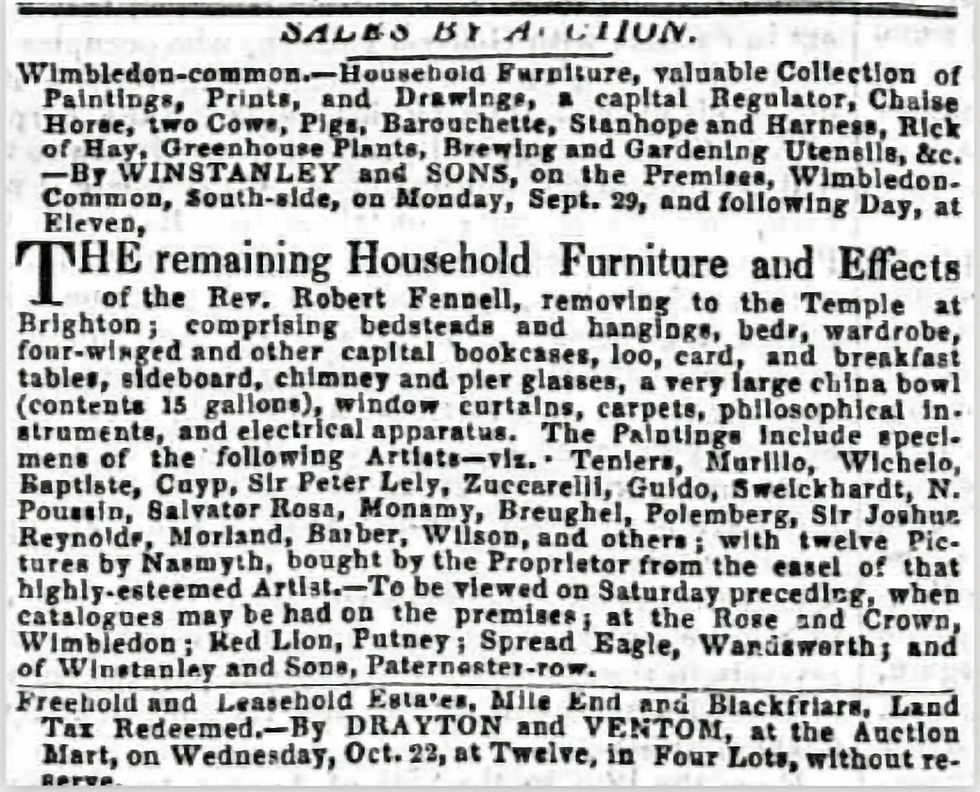
In September 1828, the Fennells' "remaining" assets were advertised for auction at their property on Wimbledon Common. The list of valuable sale items suggest that the family lived in a substantial property but begs the question of how such quality assets were both accrued and funded. His father, Thomas's, will gives no clues, Mary, his wife, being the main benefactor while Robert was the youngest of their three children.
Charitable work
From the autumn of 1829, we start to see evidence of Fennell’s involvement in initiatives to assist the town's poor through both regular and one-off donations to charitable causes. He also joined several charitable committees, among others the Brighthelmston National Schools Committee and the Brighthelmston Bank for Savings, which promoted "the comfort and independence of the poor”.
Schoolmaster, Headmaster?
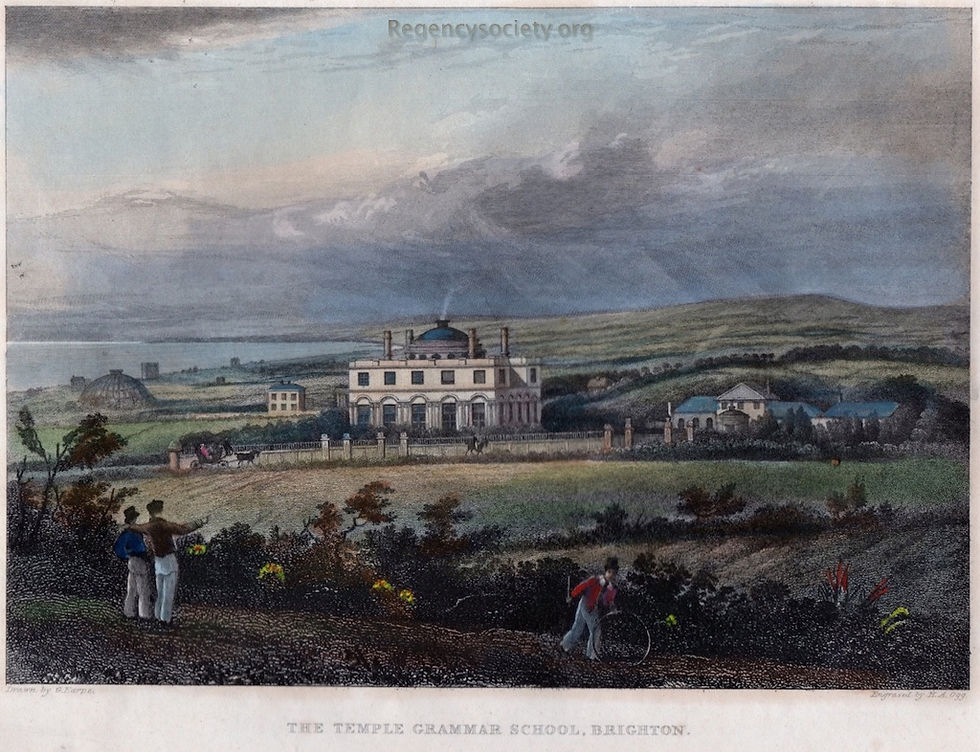
This engraving, dating from c1835, shows the Temple before significant development of the surrounding area; the smartly-clad boys could well be pupils at Fennell's school.
Local historian Eric Underwood's slide presentation from the 1970s, entitled 'The Palmers of Montpelier Road', offers further insights - and conjectures - regarding Fennell's tenure at the Temple School. Although the Palmers, a distinguished military family, lived nearby at 9 Montpelier Road, their ten-year-old son, John Jervis Palmer, was a boarder. On June 2nd 1831, he writes to his father:
"My dear Papa,
The vacation is appointed to commence on the 15th instant when I hope to join our family circle and to enjoy for a season the delights of home.
I am permitted to say my conduct of late has been entirely satisfactory whether regarding diligence in my several studies or my general behaviour and I trust that during my holidays it will be such as to meet your approval.
Pray I have been affectionately represented to my very dear Mamma, Brothers and Sisters & believe me always,
My dear Papa,
Your dutiful son
John J Palmer
This letter (shown in the presentation) is written in "the most immaculate copperplate without a single blot, mistake or erasure", which leads Underwood to speculate whether Revd Fennell had supervised its composition "with a supple cane in his hand". He supports this hypothesis with an image of Revd Fennell himself, drawing attention to the "cold and quelling eye which might well have put the fear of God into small boys". Having found no other images of Fennell, I’d love to see this slide!
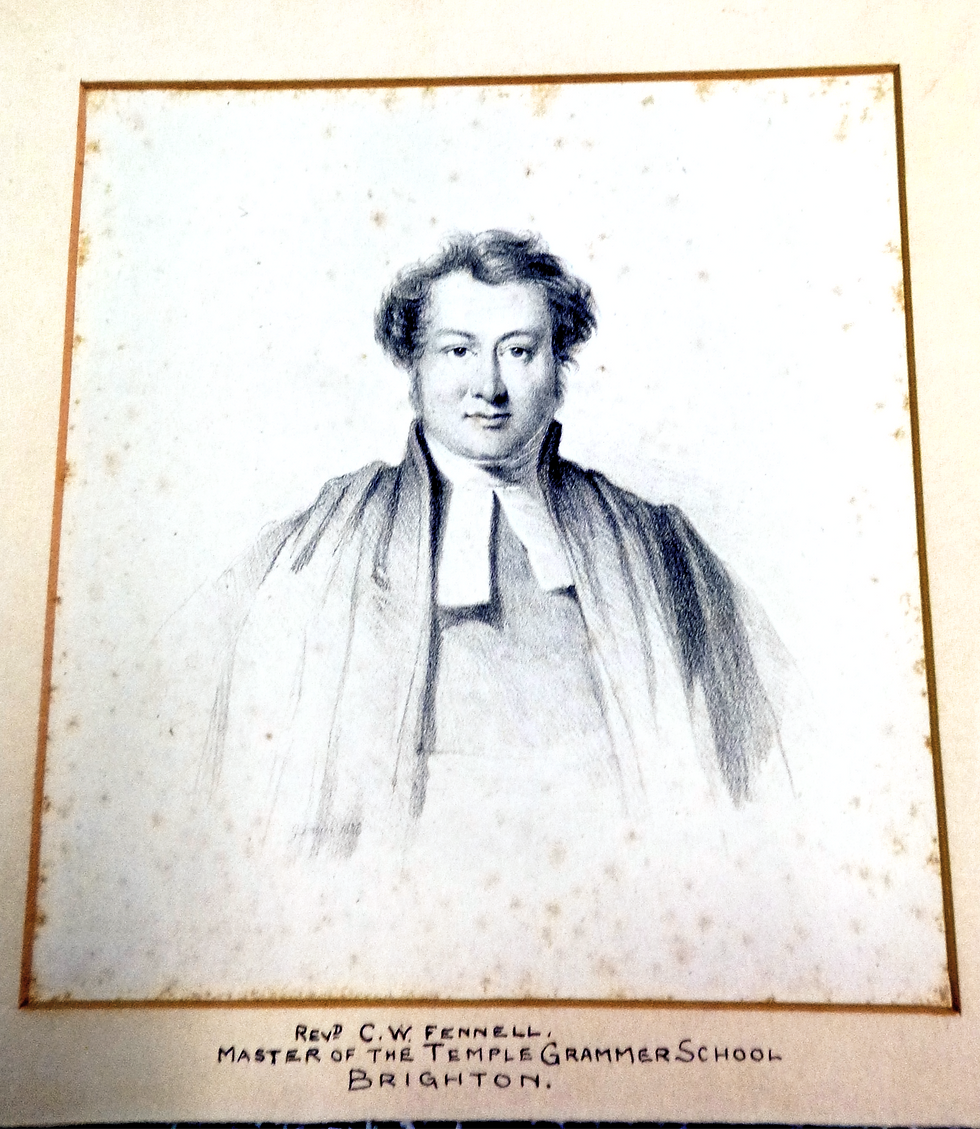
Discovering the above engraving added further complexity regarding who was responsible for what and when at the Temple School. This genial looking fellow not only fails to support Underwood's headmasterly “cold and quelling eye” interpretation but perhaps also appears a little too young to be Robert, who would have been in his late forties at this time. Although Charles William (CW) Fennell was one of Robert and Elizabeth's sons, he would have only been in his late teens in the mid-1830s while there is no documentary evidence to indicate that he was ever ordained.
However, Charles's older brother, George Keith Fennell, was ordained, albeit not until 1840 as deacon and the following years as priest. If the engraving does portray him, the date c1835 is perhaps questionable but otherwise aligns with Crockford's Clerical Directory, which identifies George as "Head Master" at the Temple School between 1836 and 1846, the year the Fennell family left.
What then was Revd Robert Fennell up to as the 1830s progressed? The local press records private lectures, concerts and dinners taking place at the Temple. In the late summer of 1830, a fancy transparency (translucent image on a cloth banner, illuminated from behind) and "festoons lighted with variegated lamps” adorned the property in honour of William IV and Queen Adelaide’s first visit to the town. The Brighton Gazette, reporting on the town-wide celebrations on September 2nd 1834, notes that "this illumination had a very good effect".
Potshots at pigeons and parsons
Yet all was not well. On January 16th 1834, the Brighton Gazette reports on Robert Fennell's formal complaint made three days' earlier at the local Magistrates Court regarding “the constant annoyance and danger to which himself and family were subjected by persons shooting at small birds in the vicinity of his house”. Already, he claimed, two of his sons had been injured by “random shots” while a few days later, he had remonstrated with two men carrying guns he'd encountered outside his gate. On receiving an impertinent answer from one of them, he'd requested his name, which was refused, the individual adding that he would shoot where he pleased. Fennell made enquiries, discovering that he was dealing with a builder, Richard Edwards, who was “a well known leader of the Radicals of this town”. As he pointed out, ". . . the time has not yet come when parsons and pigeons are to be shot at with equal impunity”, and the Magistrates duly agreed to give the matter “every consideration”.
"A hater of parsons"
Three days later, the case returned to court:

Throughout the long and heated hearing, Fennell was unmercifully challenged. Although he managed to keep his cool, the case was ultimately dismissed as the magistrates were divided. Unsurpisingly, within days there was a significant increase in the firing of guns on the town's outskirts and, to add insult to injury, in June that year, George Faithfull MP was presented with a silver salver "in commemoration of his triumphant vindication of the rights of sportsment in the defence of Richard Edwards. . ."
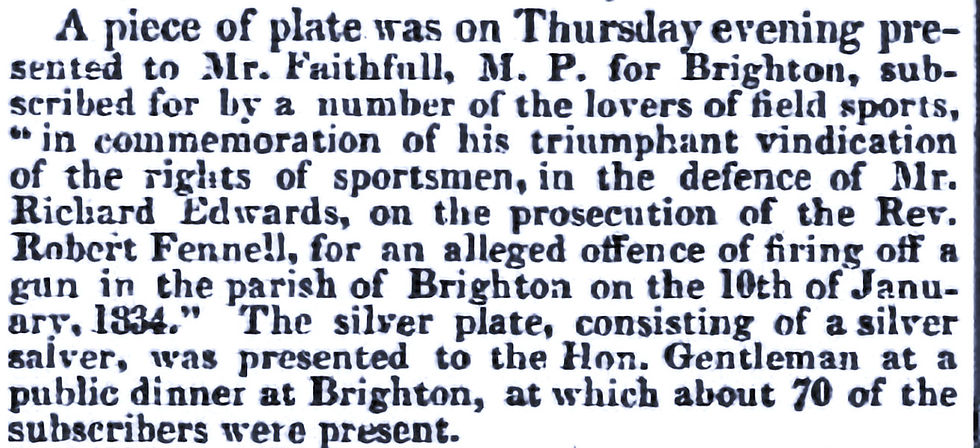
Although the Brighton Gazette report identifies Henry Faithfull, rather than his brother George, as acting for the defendant at the full hearing, they would have been of one mind on this issue. Both were solicitors, partners in the firm G & H Faithfull based at 15 Ship Street. Somers Clarke, a solicitor practising nearby, notes that, although "clever", they weren't "gentlemen". George, known as 'Black George', had several other strings to his bow, including non-conformist preaching and serving as a Radical MP for the town from 1832 to 1835, when he was noted for holding extreme views. When defeated at the next election in 1835, he established his own newspaper, the Brighton Patriot, to promulgate these extreme views more effectively.
A gentlemanly disagreement
In "The Records of Creation", his prize-winning theological treatise of 1816, John Bird Sumner seeks to resolve the incompatibility between the Biblical account of the Creation and the science of Geology. The work ran to seven editions, suggesting compelling arguments and, as Sumner rose through the ecclesiastical ranks ultimately to the status of Archbishop of Canterbury, it can’t have proved an obstacle to his career progression either.
Twenty years later, in 1836, Revd Fennell released a counter-treatise, "Remarks on Bishop Sumner’s 'Appendix' to his work “The Records of Creation”. In this work, he meticulously, if verbosely, dissects Sumner’s arguments, invoking scholarly citations, Biblical references, extracts from Shakespeare and others, the whole being liberally peppered with Latin phrases.
What fossil remains were thought to reveal about creation was Fennell's primary concern. Nevertheless, although the precise term 'paleontology' had come into use by 1836, he sticks with Sumner's generic 'geology'. His adversary, the surgeon, geologist and paleontologist, Dr Gideon Mantell, who had moved from Lewes to 20 Old Steine Brighton in 1833, is targetted by name six times, obliquely yet identifiably elsewhere. Fennell had certainly done his homework. As he notes at the start of the treatise, he'd spent a great deal of time among geologists, some “of great celebrity”, and had even helped them “make public the results of their enquiries”. Indeed, he was an enthusiastic, paid-up member of the Sussex Scientific Institution and Mantellian Museum.
The final ten pages of Fennell’s work, a synthesis of his findings and conclusions, are written in verse. At least this was clearly the intention although several contemporaries weren’t convinced he’d fulfilled that aim! Here are two extracts:
PURSUE ye Science, if it give delight,
Yet know, the most sublime of its attempts
Is but a guess confess'd. . .
Descend! we cry -
Descend, proud Science, from thy pinnacle!
'Tis based on sand, and totters to thy ruin. . .
Mantell’s response
Whilst embracing several other trenchant allusions, Fennell’s dubious verse is the main thrust of Mantell’s quizzical response, published in the Brighton Guardian on June 22nd 1836:
A Poetical Case
The Muses Versus the Rev Robert Fennell A.M.
Buy a Mackerel
All ruffled in look and disordered in mien.
A-climbing the steeps of Parnassus were seen
Just emerged from some classical hollow,
The daughters of Jove, the nine Muses so fair
To the summit they strained, and their object when there
Was to make a complaint to Apollo.
And “oh! Be it spoken with reverence due,” †
Calliiope said, “if we state what’s cted with blisters;
We come to complain of one Fennell by name,
“A parson and schoolmaster – more to his shame –
"Which takes freedoms with me and my sisters.
“Oh! fie! cried Apollo, “tis you that are wrong
“You shouldn’t encourage such fellows; ‘ere long
Your virtuous names will be tainted.”
“Alas,” said the virgins, “to make it the worse
“We bring you his book; if you look at his verse,
“You’ll see we’re no way aquainted.”
†Vide the Reverend’s book (Passim)
It should be noted that Fennell and Mantell’s communications were courteous. at least in the public domain. Indeed, Fennell writes at the start of his treatise:
“If I have ventured to call in question the doctrines of some, whose talents have acquired for them an extensive fame, I assure them it is with no ill-temper, and that it was with no small effort of mental courage I applied myself to the task.”
Mantell was similarly courteous when, in his address to the Institution’s first members’ annual dinner, held in December 1836, he assured Fennell that, regardless of their differences, “he felt the same towards him he had ever done”.
The demise of Robert Fennell
The Mantellian Museum at 20 Old Steine went from strength to strength enjoying, at its peak, the patronage of aristocracy and royalty. Why it didn’t last long is a sad tale told elsewhere. Suffice to say here that 1838 was an annus horribilis for both Mantell and his equally respectful adversary.
Revd Robert Fennell died in January 1838, the Brighton Patriot commenting, with barely contained glee:
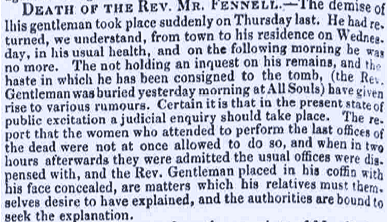
Whether the death was as sudden and unexpected as chronicled in this report should, though, not be taken as read. Fennell had accrued enemies during his time in Brighton, certainly among the Radicals, which suggests that the Patriot's owner, George Faithfull, might have intentionally deviated from the actual facts here. Official records show that Fennell's death, from hepatitis, was reported to the authorities by John George Snowdon, "assistant classical master to the deceased", a resident at the Temple, as having occurred on Monday 22nd January 1838, i.e. not the following Thursday. This event was registered on 29th January, the same day as the burial, which took place not four days after Fennell's demise but a respectable seven. The records of funeral directors, Attree & Kent, confirm that it was arranged with due care and attention too.
Fennell was buried in the crypt of All Souls, Kemp Town, a new church with which he had been closely associated and which served a poor area. The ceremony was conducted by Revd Henry Wagner, Vicar of Brighton. When All Souls was demolished in 1968, the deceased could only be removed by smashing the tombs. The remains of Revd Fennell and six earlier burials were then reinterred in an unmarked grave at Brighton Extra-Mural Cemetery.
FOOTNOTES
The impressive Colnbrook One Place Study provides credible evidence that Thomas, Robert's Fennell's father, had another talent besides carpentry. If this was indeed the same individual who died in 1822 as an auctioneer and appraiser in Windsor, Berkshire, it could offer insights into the provenance of some artefacts in Robert's collection.
A further auction was held at the Temple in 1846, the year the Fennell family left the property, the newspaper advertisement highlighting "a breast and back plates found on the plains of Waterloo, immediately after the Battle". Someone, at any rate, had seized the opportunity for a safe, souvenir garnering trip to the Continent as soon as the Napoleonic Wars finally ended in 1815.
POSTSCRIPT
Men reflect little, read negligently, judge with precipitation, and receive opinions exactly as they do money, because they are current.
From the title page of Revd Fennell's counter-treatise, published 1836.
Quo magis mutans eo magis idem as he might well exclaim were he alive today!


